What Veri*Factu Is and Who Actually Has to Comply
If you run a business in Spain — or sell into Spain through a Spanish entity — you have probably been told you need to adapt to Veri*Factu. What almost nobody explains clearly is who is actually obliged, from when, and what happens if you ignore it.
One thing first, because it matters: the deadlines changed in December 2025. A lot of what is still online gives dates that no longer apply.
What Veri*Factu is
Veri*Factu is not a program or a government platform. It is a set of requirements your invoicing software has to meet.
It comes from Royal Decree 1007/2023 and its technical development, Order HAC/1177/2024. The purpose is simple: once an invoice is issued, it must not be possible to alter or delete it without leaving a trace.
To achieve that, your invoicing system has to:
- Generate an invoicing record for every invoice, at the moment it is issued
- Chain each record to the previous one with a digital fingerprint, so tampering with an old invoice breaks the chain visibly
- Electronically sign those records
- Include a QR code on the invoice so the recipient can verify it
In short, an invoice stops being a document you fully control and becomes a traceable record.
The two modes
This is where the name misleads people. **Veri*Factu is one of two possible modes**, not the obligation itself.
**Veri*Factu mode (voluntary submission).** Your software sends each invoicing record to the Spanish Tax Agency (AEAT) as the invoice is issued. In exchange you get lighter obligations: no event log and no electronic signature of the records are required, because the AEAT is your witness.
Non-verifiable mode. You send nothing to the tax authority, but your system must keep a complete event log, electronically sign every record, and retain everything for inspection.
Both are legal. The first is simpler to maintain; the second keeps your data in-house.
What is not an option is carrying on with software that does neither.
Who has to comply
Anyone who issues invoices using an invoicing system:
- Companies and other Corporate Income Tax payers
- Self-employed professionals taxed under personal income tax (IRPF) on business activity
- Permanent establishments of non-resident entities
- Income attribution entities carrying out an economic activity
That third one catches a lot of foreign businesses by surprise. If you have a permanent establishment in Spain, this applies to you.
Who does NOT
- Anyone invoicing by hand or with something that is not an invoicing system. Four handwritten invoices a year is not in scope
- Anyone already on SII (Immediate Supply of Information), because they already report invoicing records in near real time
- The Basque Country and Navarre, which have their own regional regime (TicketBAI) and their own calendar
- Certain specific operations and regimes
If your case is borderline, your tax adviser settles it in five minutes. Do not assume.
The deadlines, updated
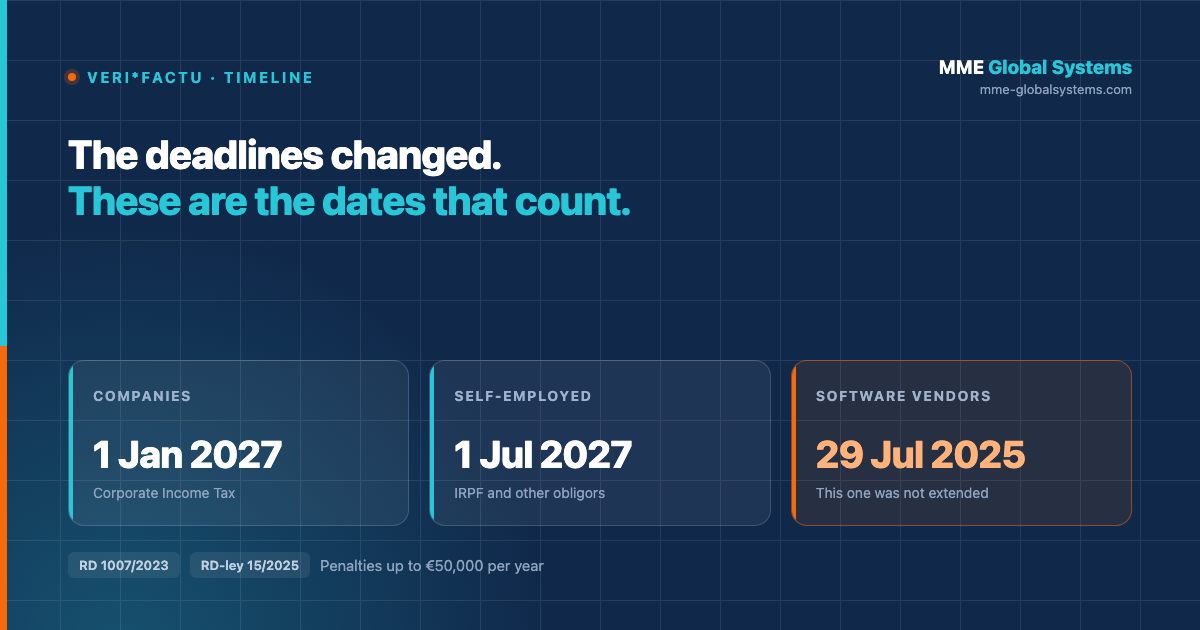
Royal Decree-law 15/2025, of 2 December, published in the Spanish Official Gazette on 3 December 2025, extended the deadlines for the second time.
| Who | Deadline |
|---|---|
| Corporate Income Tax payers | Before 1 January 2027 |
| Everyone else: self-employed under IRPF, permanent establishments, income attribution entities | Before 1 July 2027 |
| Software developers and vendors | Since 29 July 2025 |
Look at that third row, because most people miss it.
The deadline for software makers did not move. Since 29 July 2025, any company developing or selling invoicing software in Spain must already have a fully compliant product on the market. The extension was for users, not for the people who build the software.
What that means for you as a user: your provider should already be ready today. If they still tell you they are “working on it for 2027”, they are not meeting the rule that already applies to them.
What happens if you do not comply
The penalties sit in article 201 bis of the Spanish General Tax Act, and they bite because they do not depend on you having evaded anything:
- €50,000 per financial year for holding or using an invoicing system that does not meet the requirements. The tax authority does not have to prove you used it to hide income — possession is enough
- €150,000 per financial year and type of system for producing or marketing non-compliant software
They can accumulate across years.
This is a penalty for a formal breach, not for fraud. That is the important distinction: it is not about having your accounts in order, it is about having the right software.
What to do now
Even if your own deadline is 2027, three things are worth settling early:
1. Ask your current provider whether they already comply. Not whether they will — whether they do today, which is what the law has required of them since July 2025. Ask for the declaración responsable, the formal statement in which the manufacturer certifies that their system meets the regulation.
2. Check which mode you will run in. Veri*Factu or non-verifiable. It changes what you have to store and what gets sent to the tax authority.
3. Do not leave it to the last quarter. Switching invoicing software means migrating clients, invoice series and historical data. Doing that in December, on top of year-end, is the worst possible plan.
Frequently asked questions
**Is Veri*Factu the same as mandatory e-invoicing?** No. They are two separate rules that get confused constantly. Veri*Factu (RD 1007/2023) is about your invoicing software being tamper-proof and falls under the tax authority. Mandatory B2B e-invoicing comes from the Crea y Crece Act, is about the format invoices are exchanged in, and falls under the Ministry of Economy. You may well be subject to both.
Do I have to send my invoices to the tax authority? Only if you choose Veri*Factu mode. In non-verifiable mode you send nothing, but you must keep the event log and the signatures.
I invoice on paper or with a template. Does this affect me? No, as long as you are not using an invoicing system. The moment you use software, yes.
I am already on SII. Am I obliged too? No. Businesses on the Immediate Supply of Information already report their records and are out of scope.
What if I am in the Basque Country or Navarre? They have their own regional rules (TicketBAI) with a separate timetable. Check with your adviser.
Can I keep my current software? Only if its maker has adapted it. If the program is no longer maintained, it will never comply and it has to be replaced.
We built ours from the inside
MME Factu is our invoicing tool, built for Veri*Factu: chained records, signature, QR code and both operating modes. We built it because we had to solve this in our own business first.
From €9.99 a month, nothing to install.
Last updated: September 2026. This article is informative and does not replace your tax adviser’s judgement. Reference legislation: Royal Decree 1007/2023, Order HAC/1177/2024 and Royal Decree-law 15/2025.